In my last post, I described the importance of drawing a clear connection between the idea of related rates and the concept of a composed function. In this post, I will describe a way to introduce the chain rule using related rates. I like to think that this is the “this actually makes sense” intuition for the chain rule that many people wish they had and many calculus teachers wish they could convey. Sam J Shah has another take on how to make the chain rule approachable, which is a bit more mathematical and a bit less physical.
Here is the image at the top of the packet I use to introduce the chain rule:
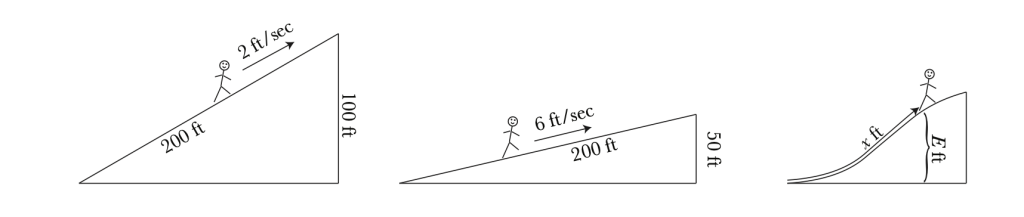
We have someone walking up a hill, so that their elevation is a function of position which, in turn, is a function of time. How fast are they gaining elevation?
With a bit of thought, most students can infer that the person on the left is gaining elevation at a rate of 1 ft per second:
- They are moving at a rate of 2 ft per second and
- for each foot they move, they gain 1/2 ft of elevation.
- Multiplying these two ratios (ft moved per second and ft of elevation gained per ft moved) gives us their rate of change in elevation per time.
Similarly, the person in the middle is gaining elevation at a rate of 1.5 ft/sec.
If we call elevation E, position x and time t, then we can recognize these three ratios as \(\scriptsize \frac{{\rm d}x}{{\rm d}t}\), \(\scriptsize \frac{{\rm d}E}{{\rm d}x}\) and \(\scriptsize \frac{{\rm d}E}{{\rm d}t}\). Furthermore, we can see that $$\frac{{\rm d}E}{{\rm d}t}=\frac{{\rm d}E}{{\rm d}x}\frac{{\rm d}x}{{\rm d}t}.$$
This is all simple because the functions involved are linear, which means the rates of change are constant.
The chain rule is an instantaneous version of this claim, applicable when rates of change are nonconstant. Even if the rates of change are not constant, it is still true that \(\scriptsize \frac{{\rm d}E}{{\rm d}t}=\frac{{\rm d}E}{{\rm d}x}\frac{{\rm d}x}{{\rm d}t}\). Critically, however, to find the rate of change at a given time, we must use the value of \(\scriptsize \frac{{\rm d}E}{{\rm d}x}\) at the position corresponding to the given time. In other words, $$\frac{{\rm d}E}{{\rm d}t}=\frac{{\rm d}E}{{\rm d}x}\frac{{\rm d}x}{{\rm d}t}=E'(x(t))\cdot x'(t).$$ Here, \(\scriptsize E’(x(t))\) is the rate of change in elevation per distance moved, at time t. Although the derivative is taken with respect to x, we need the value of this derivative at a specific time t—the same time at which we are evaluating \(\scriptsize x’(t)\).
The packet I linked at the top of this post takes students through this idea one step at a time. Students are given specific functions for \(\scriptsize E(x)\) and \(\scriptsize x(t)\) and asked to find the rate of change in elevation per time. To do this, they compute both \(\scriptsize E’\) and \(\scriptsize x’\), find the value of both these functions at the time in question, and multiply the two rates to get the net rate of change in elevation.
For example, if \(\scriptsize x(t)=t^2\) and \(\scriptsize E(x)=\sin(x)\), then \(\scriptsize \frac{{\rm d}x}{{\rm d}t}=2t\) and \(\scriptsize \frac{{\rm d}E}{{\rm d}x}=\cos(x)\). Pick a specific time, say t=3. At this time, x=9 and therefore $$\frac{{\rm d}E}{{\rm d}x}=\cos(x)=\cos(9)\ \ \ \ \ \ \ \ \ \text{and}\ \ \ \ \ \ \ \ \ \frac{{\rm d}x}{{\rm d}t}=2t=6.$$
Thus, $$\frac{{\rm d}E}{{\rm d}t}=\frac{{\rm d}E}{{\rm d}x}\frac{{\rm d}x}{{\rm d}t}.=\cos(9)\cdot 6.$$ And, more generally, $$\frac{{\rm d}E}{{\rm d}t}=\cos(t^2)\cdot 2t.$$
And now your students have just done a chain rule problem without you having done any direct instruction at all!
The rest of that packet pushes the chain rule in some other familiar related rates contexts. For example, suppose we are given a balloon’s radius as a function of time. If you guide students to think about the meaning of each expression, they will pretty quickly see that $$\frac{{\rm d}V}{{\rm d}t}=\frac{{\rm d}V}{{\rm d}r}\frac{{\rm d}r}{{\rm d}t}=4\pi(r(t))^2\cdot r'(t).$$.
And now they are off and running, ready to apply the chain rule both to related rates problems and to differentiating composite functions like (r(t))^2.
Incidentally, the balloon example is also nice because the expression $$\frac{{\rm d}V}{{\rm d}t}=4\pi r^2\frac{{\rm d}r}{{\rm d}t}$$ has a nice connection to the ideas of this post which are also explored here and here. Namely, the rate of change in volume is surface area times rate of change in radius. Why? Because the rate of added volume equals the rate of added “depth” multiplied by the area over which that depth is spread. While I previously approached this in terms of local linearity, the related rates approach here is another way of thinking about the same idea.
An aside about where this approach came from: When I was tutoring calculus at Yale, I got so many questions about the classic “water dripping out of the cone” problem. I found it tremendously helpful to start with some common sense questions: “If you fill a narrow cup at a faucet, does it fill fast or slow? How about a wider one?” People’s everyday experience tells them that narrow things fill faster. Then I’d follow up with “ok, so part of the cone is narrow and part of it is wide. That means that the water level changes at different rates, depending on what part of the cone is filled.”
None of that gives a clear solution to the cone problem, but it gives students a conceptual framework in which the question makes sense. And, when we solve the problem, they see that the math is affirming something that feels both meaningful and correct.
It struck me that, by teaching the chain rule first and related rates second, we were embedding an intuitive idea within a much less intuitive one. Why not go the other way? The approach here is to start with what feels familiar and comfortable, then leverage that to make some sense of a more general and complicated problem.
Depending on your style, you may want to follow this up with a more mathematical proof. If so, I recommend something like the approach here, which pushes in the direction of an epsilon-delta proof but without really getting into the thorny parts. Regardless of how proof-oriented you are, I think that there is value in having students believe and understand a result before proving it. A proof is always much more approachable if students have a conceptual frame in which to understand the theorem itself.
If you like this and want a copy of my whole book, please click here
Leave a Reply