In a word, no.
But it’s a great question with a really interesting answer. If you ever have a student in your calculus class ask this question, then you are doing something very right.
But let’s take a step back. What does the title of this post even mean? As discussed in my last post, the MVT states that f’ (if it exists on a closed interval) must equal its average value somewhere in that interval. And it is clearly true (thanks to the IVT) that any continuous function equals its average value at some point in a closed interval. This suggests that we can easily prove the MVT by invoking the IVT. The “proof” goes like this:
- f’ is continuous.
- Applying the IVT to f’ thus proves that f’ takes on its average value (and also all other values between its maximum and minimum).
Unfortunately, this “proof” is completely wrong. Why? Because f’ need not be continuous even if it is defined everywhere on an interval. The remarkable thing about the MVT is that it guarantees that the function f’ takes on its average value even if f’ is not continuous. In fact, more than that is true: f’ has the intermediate value property on any interval where it is defined (i.e. it takes on all values between f(a) and f(b)).1
To summarize: If f’ exists on an interval, then it has the intermediate value property even if it is not continuous.
This fact raises an interesting and important point, which is that the intermediate value property is not the same as continuity. Students often fail to see the point of the IVT because they think something like “well, duh. Isn’t the Intermediate Value Property basically what continuity is?” And, no, it isn’t. The IVT states that continuous functions always have the intermediate value property, but the converse is not true. A function can have the intermediate value property yet fail to be continuous.
How is this possible? A good example is the function$$f(x) = \begin{cases}
sin(\frac{1}{x}), & \text{if } x < 0 \\
0, & \text{if } x = 0
\end{cases},$$whose graph is shown here:
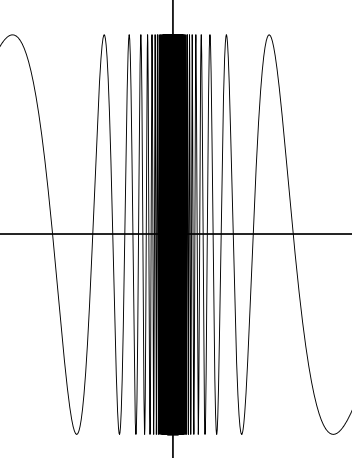
This has the intermediate value property: pick any two points (a, f(a)) and (b, f(b)) on the graph of f. If you follow the graph from (a, f(a)) to (b, f(b)), you will pass through all y-values between f(a) and f(b). However, it is not continuous at 0: in any interval containing 0, the function takes on all values between -1 and 1, so f cannot approach a limit at x=0 and therefore is not continuous.
It turns out that derivatives can be things like this: even though f’ (if it exists) always has the intermediate value property on an interval, it is not necessarily continuous. A good example is something like \(\scriptsize f(x)=\frac{\sin(\frac{1}{x})}{x^2} \). If you define f(0)=0, this turns out to be differentiable, yet has an oscillatory derivative which, like the picture above, fails to be continuous despite having the intermediate value property.
If you like this and want a copy of my whole book, please click here
- Proving that derivatives have the intermediate value property is no harder than proving the MVT. If one uses the standard method of proving the MVT using the extreme value theorem, then it can be easily modified to get the more general result. I’m opposed to using this proof in a Calc 1 class, but if you do use this proof then you might as well prove that derivatives have the intermediate value property, rather than limiting yourself to the MVT. ↩︎
Leave a Reply