Category: Pedagogy and Teaching Calculus

  • Introducing the Chain Rule Part 3: Teaching Related Rates First

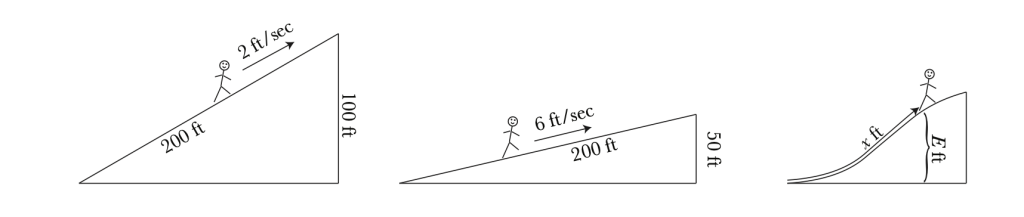
    We have someone walking up a hill, so that their elevation is a function of position which, in turn, is a function of time. How fast are they gaining elevation?

    (more…)
  • Introducing the Chain Rule, Part 2: Connecting Composition and Related Rates

    One reason that so many students struggle with the chain rule is that they never really got the point of composition in the first place. Sure they can “put one function inside another,” but they are missing this essential point:

    Composite functions appear in situations where the value of one quantity is determined by another, which in turn is determined by another.

    Functions appear in situations where the value of one quantity is determined by the value of another.

    Understanding composition this way builds a natural bridge between related rates and the idea of composition. For example, consider the following scenarios:

    (more…)
  • What is Calculus (Part 2)?

    In a previous post, I wrote that Calculus is the branch of math that deals with understanding the relationship between rate of change and accumulation of change.

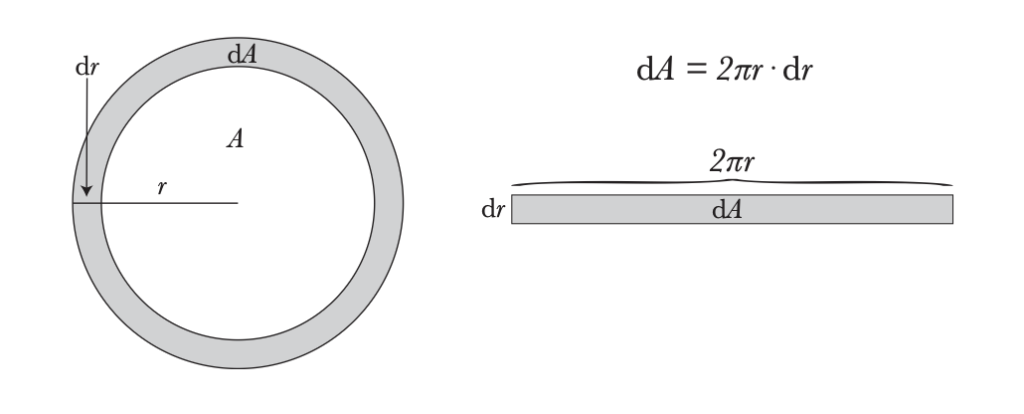
    The website Better Explained says that “calculus finds patterns between equations,” and specifically mentions the connection between the area of a circle \(\scriptsize (\pi r^2)\) and the perimeter of a circle \(\scriptsize( 2\pi r)\). Calculus relates these two: the perimeter is the derivative of the area.

    But what does the area of a circle have to do with rate of change and accumulation of change? How is this situation similar to the COVID cases used as an example in my previous post?

    Suppose we have a circle, and we imagine growing it slowly: starting with a radius of 0 and getting bigger. In the circle below, we have the accumulated area (the full circle) in white.  The gray strip around this circle shows the change in the area resulting from increasing the circle’s radius just a bit.

    (more…)
  • What is Calculus?

    One of my all-time favorite complements was from a student who told me that he loved calculus because the class is one topic all year long: we just keep learning about the same idea in more detail. Indeed, part of what I love about teaching calculus is that I see it as being a unified class, a single multifaceted concept.

    So what is the topic that I claim is the subject of calculus?

    I claim that calculus is the branch of math dedicated to understanding the relationship between accumulated change and rate of change. This is a fairly radical claim: many would say that limits (or continuous change) are the heart and soul of calculus.1

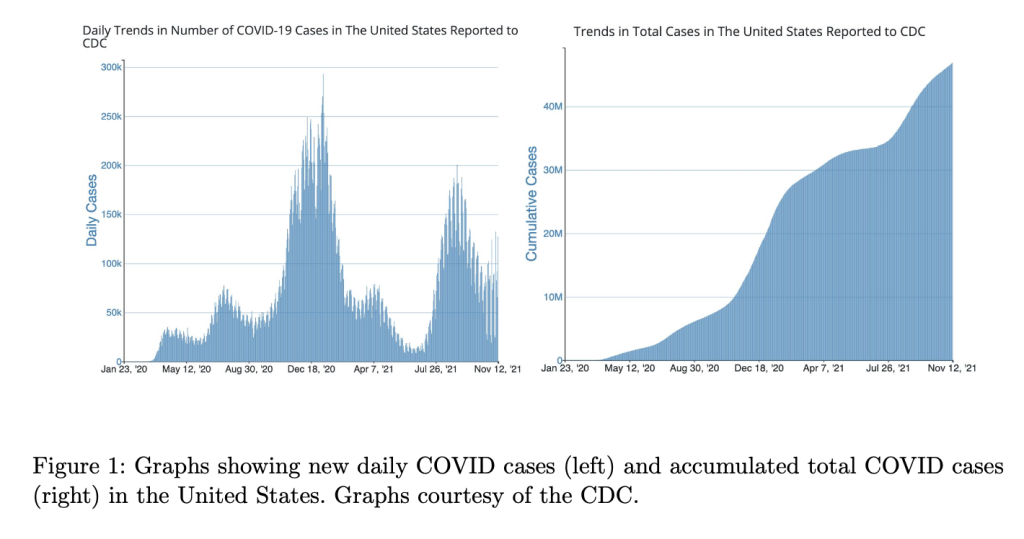
    The graphs below give a specific example of accumulation and rate of change. On the left, we have a graph showing the new daily COVID cases in the US in the first couple years of the pandemic. On the right, we have the cumulative number of cases: total cases ever recorded in the US, up to a given day.

    (more…)
  • Introducing the Chain Rule, part 1: Comparing Leibniz and Prime Notation

    I have so many thoughts about teaching the chain rule. If you just want some problems to help you introduce the chain rule in a problem-based way, I can cut to the chase: start with these problems and then move on to these ones. If you look at those problems and they make sense, you can probably use them without reading more. But if you want some extensive rumination on teaching the chain rule, I have a whole series of posts coming up for you.

    To my mind, half the battle of teaching the chain rule is helping students understand how it is that the Leibniz form and the prime form mean the same thing. On the one hand, $$\frac{{\rm d}y}{{\rm d}x}=\frac{{\rm d}y}{{\rm d}u}\cdot\frac{{\rm d}u}{{\rm d}x}$$ feels so obvious that students can’t quite see why one would bother commenting on it. But this is deceptive: derivatives aren’t just fractions and the importance of the fact that you can treat them like they are is deep and vast. On the other hand, $$(f(u))'(t)=f'(u(t))\cdot u'(t)$$ feels impenetrable: it’s hard to even make sense of this unless you are thinking very closely about where the primes are. And it takes some thought to see why one derivative is evaluated at u(t), while the other is evaluated just at t.

    (more…)
  • Some Thoughts on Introducing Limits

    Almost all calculus classes start with limits. The consensus seems to be that it is impossible to discuss derivatives or integrals without first discussing limits. But of course, calculus without limits is possible: it is just numerical calculus.

    Instead of asking “how can you talk about calculus without limits,” this post will argue that we should instead ask “how can we expect students to engage thoughtfully with limits unless they first see a problem where they are needed?”

    (more…)
  • Problems to Introduce Substitution

    One of the most useful mathematical insights I gained from working as an astronomer is that the bounds in an integral are inextricably linked to the variable of integration, and that this plays an absolutely critical role in integration by substitution. Changing the bounds when you change the variable isn’t just a shortcut or a convenience: it is an essential part of the process of substitution. And it makes total sense if we look at substitution in a physical context in which we change between two variables that actually mean something to us. The problems linked here introduce substitution by placing it in a physical context and clarifying what it really means to change the variable of integration.

    (more…)
  • Visualizations of the Fundamental Theorem

    Suppose you have done this activity, which has students use a numerical derivative to produce a growth-rate graph based on CDC growth charts. And suppose you have also done this sequence of activities, which introduces students to integration using the energy released by a supernova and culminates in the computation of an accumulation function, showing cumulative energy over time. And perhaps you’ve also had students do this problem, which gets them thinking about the connection between accumulation and rate in the context of COVID. If so, then your students have seen all three pairs of graphs shown below.

    (more…)
  • Signed Area and the Definition of the Definite Integral

    There is a long-standing tradition of defining integrals as being area and introducing accumulation as an application of this core mathematical idea. What happens if, instead, we define integrals as being accumulation and then link this idea to area? For example, I use this activity to introduce Riemann sums by first having students estimate the total energy released by a supernova over a period of time, and then leading them represent their work in terms of area.

    This approach has a clear benefit to student buy-in: students are likely to find accumulation problems more intrinsically interesting than areas. It also has a benefit in terms of giving students some intuition for integrals. For example, in the graphs above, students find it intuitive that the volume graph is steep when the flow rate graph has a large value. There is also a strong historical case for foregrounding accumulation: Newton was certainly more interested in motion than in area per se, and Babylonian astronomers tracking the motion of Jupiter were among the very earliest to use Riemann sums.1

    But you may be wondering: is this rigorous? Shouldn’t integrals be defined in terms of a mathematically clear idea like area, rather than a more ill-defined one like accumulation? This post focuses on the theoretical benefits of foregrounding accumulation. I would argue that foregrounding accumulation actually leads to a more theoretically rich (and more rigorous) framework for understanding Riemann integrals.

    (more…)
  • Numerical Derivatives and the Mean Value Theorem

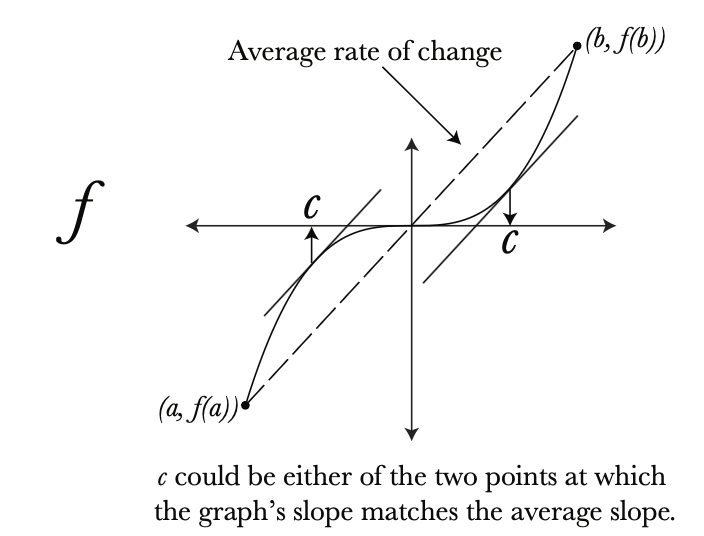
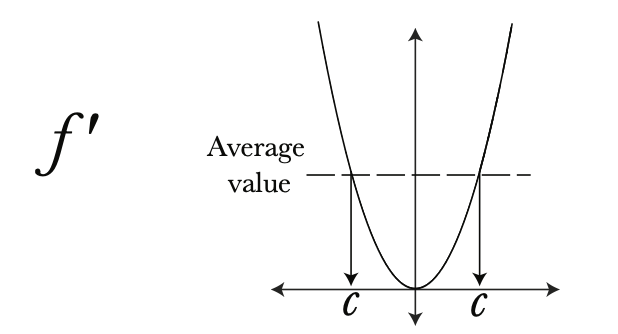
    As I outlined in an earlier post, it is challenging to give first-year calculus students a compelling reason to care about the MVT. Its theoretical importance is often lost on this audience: using the MVT to prove the Increasing Function Theorem often creates confusion rather than providing clarity. And the sorts of “applications” often introduced to a first-year class feel contrived: the classic “cop giving a speeding ticket” example is amusing, but it hardly conveys the importance of this theorem.

    However, if you’ve spent some time (even just a couple classes) with numerical derivatives, then the MVT has a clear and important meaning. Indeed, the MVT gives the answer to important questions students have likely been asking since they first encountered numerical derivatives. Before posing these questions, let’s take a brief detour to review numerical derivatives.

    (more…)