In a previous post, I wrote that Calculus is the branch of math that deals with understanding the relationship between rate of change and accumulation of change.
The website Better Explained says that “calculus finds patterns between equations,” and specifically mentions the connection between the area of a circle \(\scriptsize (\pi r^2)\) and the perimeter of a circle \(\scriptsize( 2\pi r)\). Calculus relates these two: the perimeter is the derivative of the area.
But what does the area of a circle have to do with rate of change and accumulation of change? How is this situation similar to the COVID cases used as an example in my previous post?
Suppose we have a circle, and we imagine growing it slowly: starting with a radius of 0 and getting bigger. In the circle below, we have the accumulated area (the full circle) in white. The gray strip around this circle shows the change in the area resulting from increasing the circle’s radius just a bit.
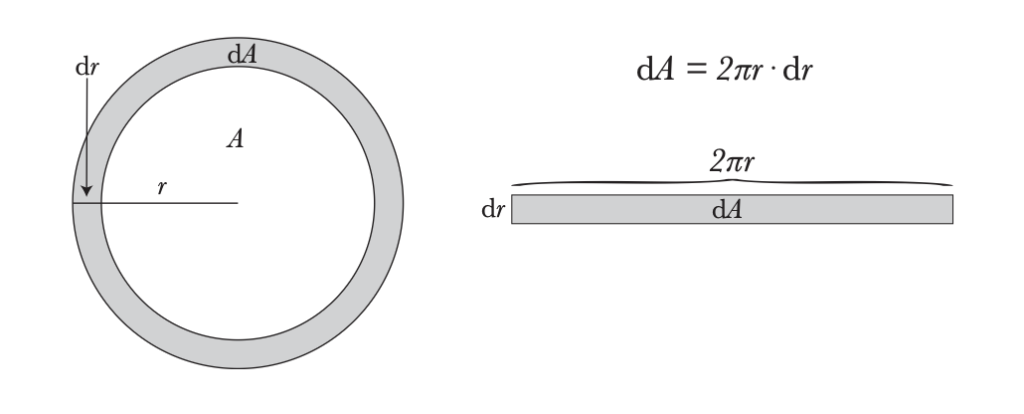
On the right, we have unwrapped this thin strip of added area so that it looks like a rectangle. If dr (a small change in r) is the added radius, this becomes the thickness of the rectangle. And the length of the rectangle is the same as the length around the circle: in other words, the perimeter \(\scriptsize 2\pi r\).
If the area of this rectangle \((\scriptsize 2\pi r\text{d}r)\) gives us the amount of added area, then the rate of added area per unit of radius is \(\scriptsize \frac{2\pi r\text{d}r}{\text{d}r}\), which is to say \(\scriptsize 2\pi r\).
Just as a daily case rate gives us the rate of change in cumulative cases per day, the perimeter of a circle gives us the rate of change in its area per unit of radius. When we increase the radius of a circle, area gets added all around the perimeter and so the perimeter determines how rapidly area gets added in response to a changing radius.
There is a similar relationship between the volume of a sphere and its surface area: the surface area \((\scriptsize 4\pi r^2)\) equals the derivative of the volume \((\scriptsize \frac{4}{3}\pi r^3)\). Why? Because adding a small bit to the radius gives us extra volume spread all over the surface of the sphere. Sam j Shah has a nice activity exploring this connection.
This video illustrates illustrates how the same idea, applied to squares and cubes, can be used to illustrate the power rule.
Now, the arguments made here have been very informal: they depend on making a “small” change in the radius, so that we can treat the strip around the circle as being equivalent to a rectangle. But how small is small enough? Can we really treat that strip as being equivalent to a rectangle? Answering these questions requires us to understand something about limits, which will be the subject of my next post.
If you like this and want a copy of my whole book, please click here