One of my all-time favorite complements was from a student who told me that he loved calculus because the class is one topic all year long: we just keep learning about the same idea in more detail. Indeed, part of what I love about teaching calculus is that I see it as being a unified class, a single multifaceted concept.
So what is the topic that I claim is the subject of calculus?
I claim that calculus is the branch of math dedicated to understanding the relationship between accumulated change and rate of change. This is a fairly radical claim: many would say that limits (or continuous change) are the heart and soul of calculus.1
The graphs below give a specific example of accumulation and rate of change. On the left, we have a graph showing the new daily COVID cases in the US in the first couple years of the pandemic. On the right, we have the cumulative number of cases: total cases ever recorded in the US, up to a given day.
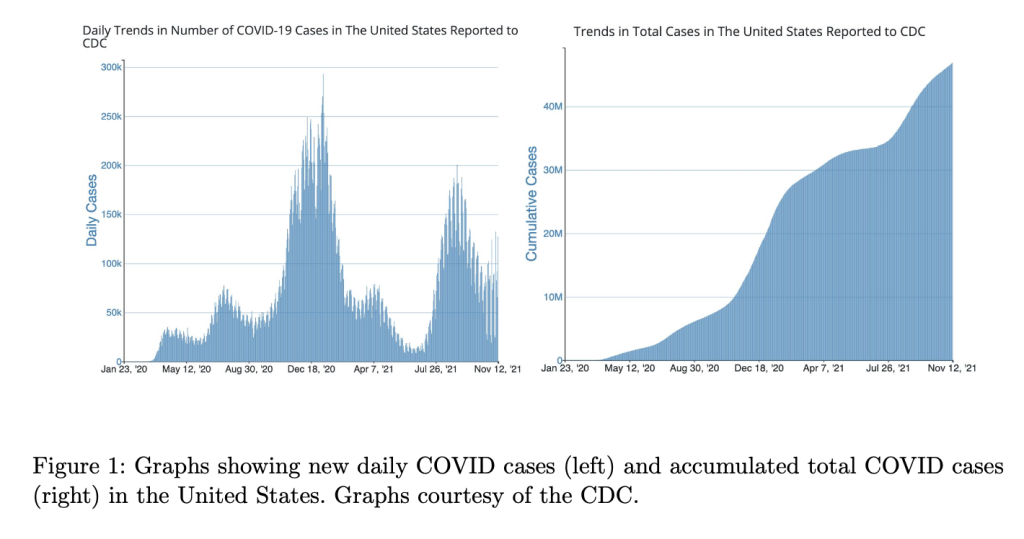
How are these connected? A value on the left (daily case rate) tells us how fast the cumulative case graph increases, which corresponds to a slope (rate of increase) on the right. Thus, slope at a point on the right graph equals the value (y-value) at the corresponding point on the left.
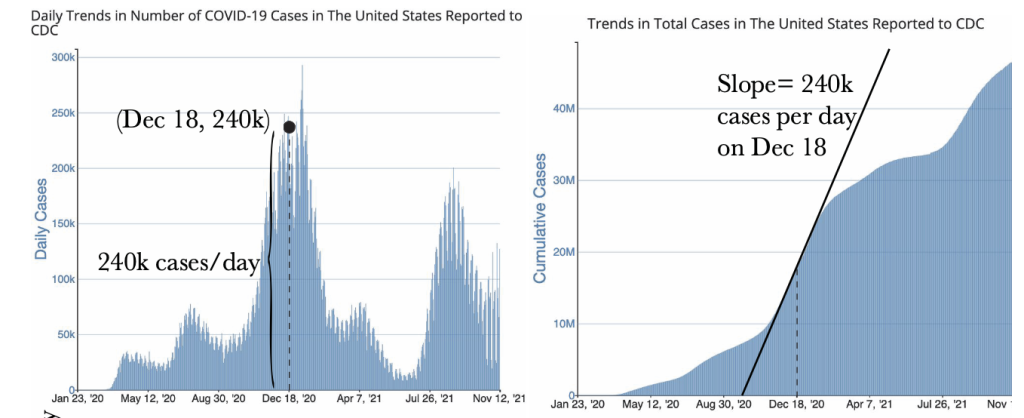
If I asked you “what is the daily case rate on Dec 18, 2020” you could answer this question by finding the slope at that time on the right-hand graph (as shown above). But it is much easier to just look at the value of the daily case rate for that day, reading off a y-value on the left rather than a slope on the right. This is what taking a derivative does: it gives you a function whose value (like the daily case graph) equals the slope of some other function (like the cumulative case graph).
A less obvious connection is that area on the left-hand graph (between two times) equals the change in the value on the right-hand graph, between the same two times. Here is an example:
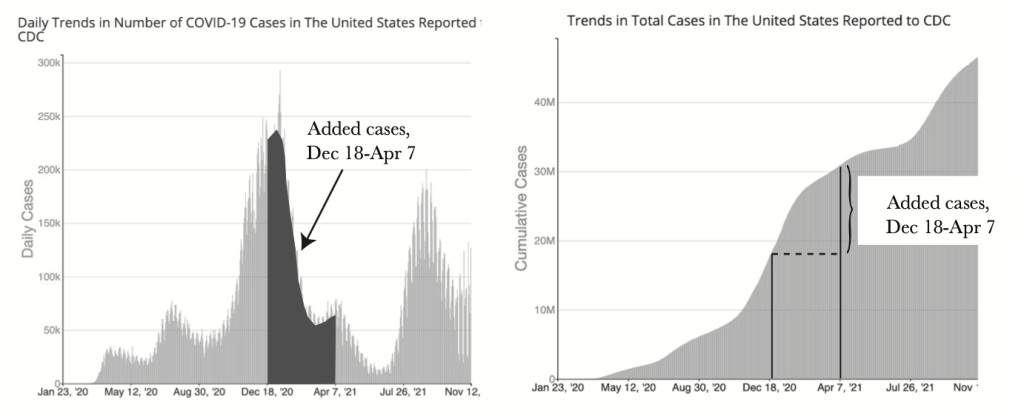
This is the point of the Fundamental Theorem of Calculus: if a pair of functions has the relationship that slope on one is value on the other, then that same pair must also have an area-value relationship as illustrated above.
If I asked you “How many new cases appeared between Dec 18, 2020 and April 7, 2021,” you could answer this question by finding the area between those times on the left-hand graph shown above. But it is much easier to just look at the change in value of the cumulative case graph: computing a change in y-value on the left is easier than computing the area (accumulation) on the right. This is what taking an antiderivative does: it allows you to compute area/accumulation on one graph (like the daily cases, above) using a change in value on another graph (like the cumulative cases, above).
So back to the original question: what is calculus? It is the field of math dedicated to understanding this sort of relationship. Given the graph on the left, how do we construct the one on the right? Given the one on the right, how do we construct the one on the left? What relationships exist between such pairs of functions? If we are just looking at one of these graphs, how do we make inferences about the other?
The website Better Explained has a somewhat different answer to the question “what is calculus.” In the next post in this series, I will connect the answer given there to the one I have given here.
If you like this and want a copy of my whole book, please click here.
- This footnote is for any mathematicians who think that calculus is the study of limits, or of continuous (not discrete) change. I disagree in part because “numerical calculus,” which involves no limits, is still very clearly part of what we call “calculus.” And the tools of calculus are useful even in situations where data might only exist at discrete time points. Anyone solving a problem involving accumulation and rate of change must use calculus, of either a numerical type or a continuous type. But there are plenty of problems involving limits that would be considered part of analysis and not “calculus” per se. Ask yourself this: if a scientist takes a numerical integral, are they not doing “real calculus?” ↩︎