Author: Andy Cantrell

  • Introducing the Chain Rule Part 3: Teaching Related Rates First

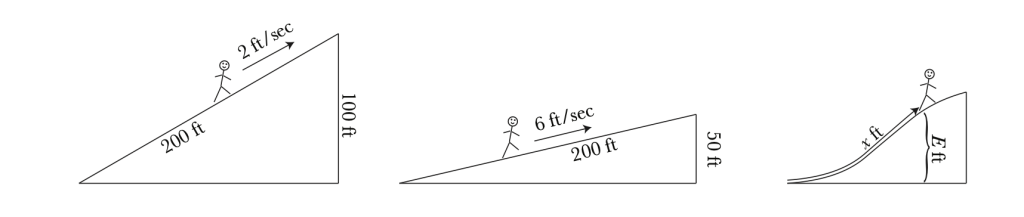
    We have someone walking up a hill, so that their elevation is a function of position which, in turn, is a function of time. How fast are they gaining elevation?

    (more…)
  • Introducing the Chain Rule, Part 2: Connecting Composition and Related Rates

    One reason that so many students struggle with the chain rule is that they never really got the point of composition in the first place. Sure they can “put one function inside another,” but they are missing this essential point:

    Composite functions appear in situations where the value of one quantity is determined by another, which in turn is determined by another.

    Functions appear in situations where the value of one quantity is determined by the value of another.

    Understanding composition this way builds a natural bridge between related rates and the idea of composition. For example, consider the following scenarios:

    (more…)
  • Scaffolding for a few of my favorite problems

    I’ve tried producing a document giving some guidance to help others use a few of my favorite problems in their classroom. This includes problems I use on the chain rule, product rule, fundamental theorem and power rule. My goal with this document is to explain some of what I do to set each problem up and debrief it at the end of class, and to describe what comes before and after a particular problem.

  • What is Calculus (Part 4: Graphs and Equations)

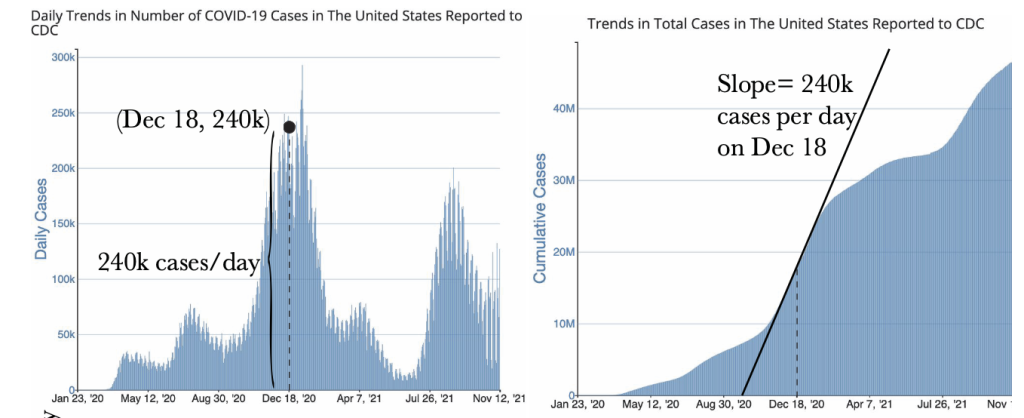
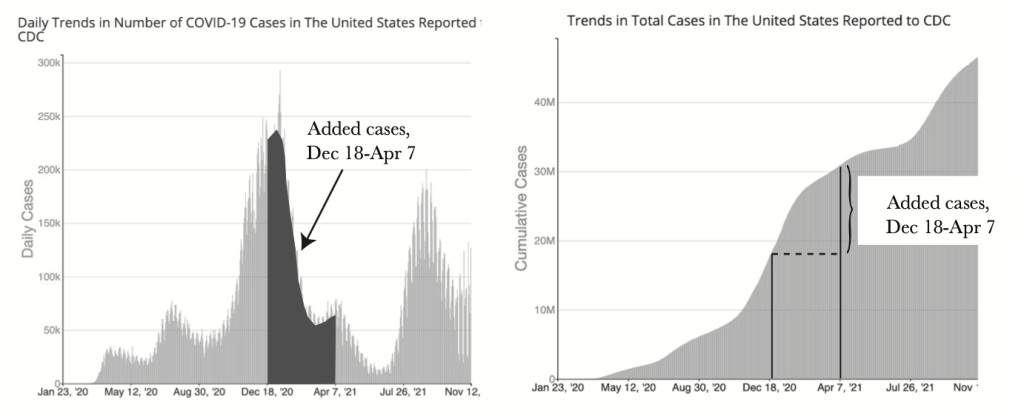
    In the first post in this series, I said that calculus is the branch of math dedicated to understanding rate of change and accumulated change.  In that post, I Illustrated two relationships between the graphs of cumulative COVID cases and daily COVID cases.

    First, the slope on the graph of cumulative cases on a given day is the same as the corresponding value (y-value) on the graph of daily cases:

    Second, an area between two dates on the graph of the daily case rate equals the change in the value between the same two dates on the graph of cumulative cases.

    (more…)
  • What is Calculus (Part 3: Why we need limits)

    In the first post in this series, I claimed that calculus is the branch of math devoted to understanding the connection between a rate of change and an accumulation of change.

    In the second post, I connected this to the idea of area: specifically that the perimeter of a circle determines the rate of change in its area, per unit change in its radius.

    In this post, we will see why limits are important for understanding these ideas.

    First, we will change notation a bit. Before, we let dr represent a “small” change in radius, without saying how small dr actually is. Now, let us say the change in the radius is some specific number that we call \(\scriptsize\Delta r\). The number \(\scriptsize\Delta r\) may be anything, small or large: it is just some amount we are adding to the radius of a circle.

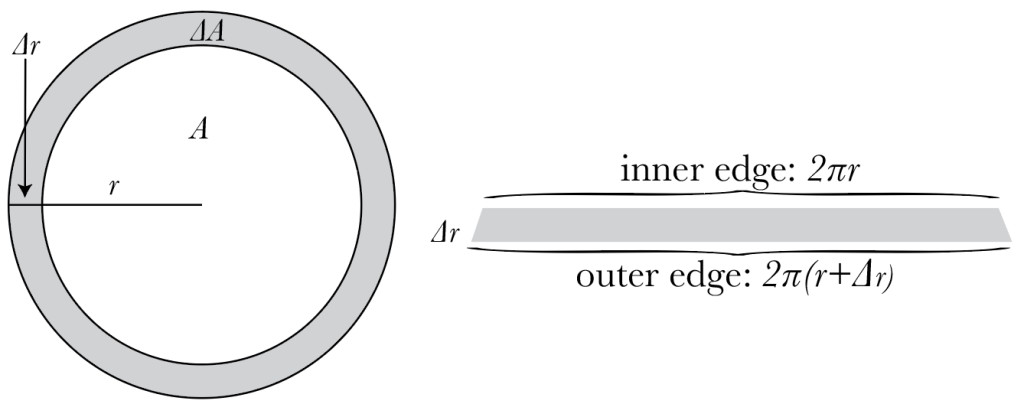
    Consider the strip formed by increasing a circle’s radius by an amount equal to \(\scriptsize\Delta r\). We previously treated this as a rectangle, but this isn’t really right, because the top and bottom have different lengths:

    (more…)
  • What is Calculus (Part 2)?

    In a previous post, I wrote that Calculus is the branch of math that deals with understanding the relationship between rate of change and accumulation of change.

    The website Better Explained says that “calculus finds patterns between equations,” and specifically mentions the connection between the area of a circle \(\scriptsize (\pi r^2)\) and the perimeter of a circle \(\scriptsize( 2\pi r)\). Calculus relates these two: the perimeter is the derivative of the area.

    But what does the area of a circle have to do with rate of change and accumulation of change? How is this situation similar to the COVID cases used as an example in my previous post?

    Suppose we have a circle, and we imagine growing it slowly: starting with a radius of 0 and getting bigger. In the circle below, we have the accumulated area (the full circle) in white.  The gray strip around this circle shows the change in the area resulting from increasing the circle’s radius just a bit.

    (more…)
  • What is Calculus?

    One of my all-time favorite complements was from a student who told me that he loved calculus because the class is one topic all year long: we just keep learning about the same idea in more detail. Indeed, part of what I love about teaching calculus is that I see it as being a unified class, a single multifaceted concept.

    So what is the topic that I claim is the subject of calculus?

    I claim that calculus is the branch of math dedicated to understanding the relationship between accumulated change and rate of change. This is a fairly radical claim: many would say that limits (or continuous change) are the heart and soul of calculus.1

    The graphs below give a specific example of accumulation and rate of change. On the left, we have a graph showing the new daily COVID cases in the US in the first couple years of the pandemic. On the right, we have the cumulative number of cases: total cases ever recorded in the US, up to a given day.

    (more…)
  • Introducing the Chain Rule, part 1: Comparing Leibniz and Prime Notation

    I have so many thoughts about teaching the chain rule. If you just want some problems to help you introduce the chain rule in a problem-based way, I can cut to the chase: start with these problems and then move on to these ones. If you look at those problems and they make sense, you can probably use them without reading more. But if you want some extensive rumination on teaching the chain rule, I have a whole series of posts coming up for you.

    To my mind, half the battle of teaching the chain rule is helping students understand how it is that the Leibniz form and the prime form mean the same thing. On the one hand, $$\frac{{\rm d}y}{{\rm d}x}=\frac{{\rm d}y}{{\rm d}u}\cdot\frac{{\rm d}u}{{\rm d}x}$$ feels so obvious that students can’t quite see why one would bother commenting on it. But this is deceptive: derivatives aren’t just fractions and the importance of the fact that you can treat them like they are is deep and vast. On the other hand, $$(f(u))'(t)=f'(u(t))\cdot u'(t)$$ feels impenetrable: it’s hard to even make sense of this unless you are thinking very closely about where the primes are. And it takes some thought to see why one derivative is evaluated at u(t), while the other is evaluated just at t.

    (more…)
  • Some of my Favorite Area Problems

    (more…)
  • Some Thoughts on Introducing Limits

    Almost all calculus classes start with limits. The consensus seems to be that it is impossible to discuss derivatives or integrals without first discussing limits. But of course, calculus without limits is possible: it is just numerical calculus.

    Instead of asking “how can you talk about calculus without limits,” this post will argue that we should instead ask “how can we expect students to engage thoughtfully with limits unless they first see a problem where they are needed?”

    (more…)