Tag: chain rule

  • Introducing the Chain Rule Part 3: Teaching Related Rates First

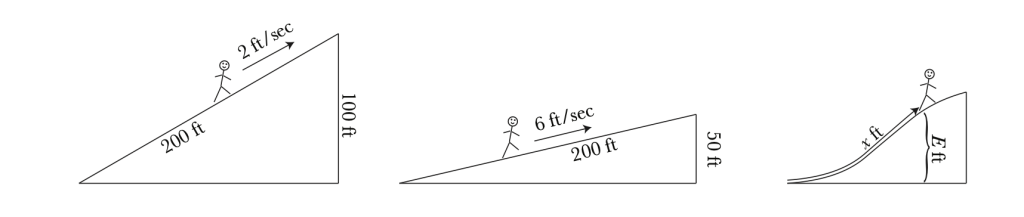
    We have someone walking up a hill, so that their elevation is a function of position which, in turn, is a function of time. How fast are they gaining elevation?

    (more…)
  • Introducing the Chain Rule, Part 2: Connecting Composition and Related Rates

    One reason that so many students struggle with the chain rule is that they never really got the point of composition in the first place. Sure they can “put one function inside another,” but they are missing this essential point:

    Composite functions appear in situations where the value of one quantity is determined by another, which in turn is determined by another.

    Functions appear in situations where the value of one quantity is determined by the value of another.

    Understanding composition this way builds a natural bridge between related rates and the idea of composition. For example, consider the following scenarios:

    (more…)
  • Introducing the Chain Rule, part 1: Comparing Leibniz and Prime Notation

    I have so many thoughts about teaching the chain rule. If you just want some problems to help you introduce the chain rule in a problem-based way, I can cut to the chase: start with these problems and then move on to these ones. If you look at those problems and they make sense, you can probably use them without reading more. But if you want some extensive rumination on teaching the chain rule, I have a whole series of posts coming up for you.

    To my mind, half the battle of teaching the chain rule is helping students understand how it is that the Leibniz form and the prime form mean the same thing. On the one hand, $$\frac{{\rm d}y}{{\rm d}x}=\frac{{\rm d}y}{{\rm d}u}\cdot\frac{{\rm d}u}{{\rm d}x}$$ feels so obvious that students can’t quite see why one would bother commenting on it. But this is deceptive: derivatives aren’t just fractions and the importance of the fact that you can treat them like they are is deep and vast. On the other hand, $$(f(u))'(t)=f'(u(t))\cdot u'(t)$$ feels impenetrable: it’s hard to even make sense of this unless you are thinking very closely about where the primes are. And it takes some thought to see why one derivative is evaluated at u(t), while the other is evaluated just at t.

    (more…)