In an earlier post, I described one visualization of the Fundamental Theorem. Another nice visualization of the Fundamental Theorem comes from thinking of part 2 (like part 1) as saying something about an integral-defined function. Suppose we write part 2 with a variable upper bound \(\scriptsize x_0\), and also write the integrand as F’ rather than f : $$\int_a^{x_0}F^\prime(x){\rm d}x=F(x_0)-F(a).$$ Written this way, part 2 of the Fundamental Theorem clearly makes a claim about the integral of a derivative.
If we use “an integral” as a shorthand for “an integral from a fixed lower bound to a variable upper bound,” then part 2 of the Fundamental Theorem says that an integral of the derivative of F differs from F by the constant value \(\scriptsize F(a)\).
And, of course, part 1 says that the derivative of an integral of f is precisely f.
In short: if we take an integral and then a derivative, we get back where we started. But if we take a derivative and then an integral, we get a function which differs from F by the addition of a constant.
Viewed this way, the two parts of the Fundamental Theorem spell out the nature of derivatives and integrals as almost inverse operations: integrals can be inverted by derivatives, but derivatives can only be inverted by integrals up to a difference of a constant, which is why indefinite integrals need a +C.
The two figures below illustrate this perspective on the Fundamental Theorem, using the example of a supernova’s brightness B and the resulting energy E. Here is part 1:
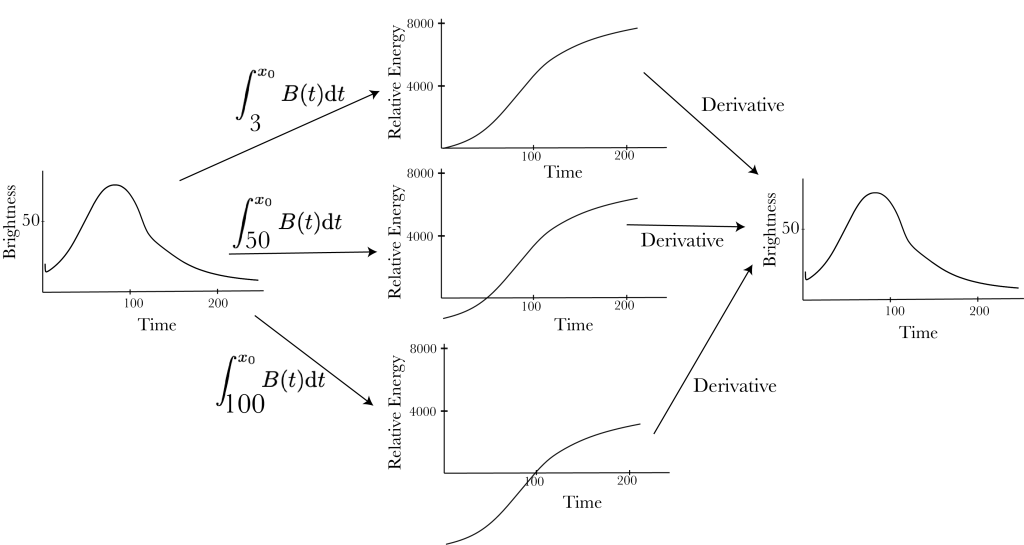
In this figure, we see that different integrals produce different antiderivatives of a given function. The various antiderivatives differ by a constant, which vanishes when we take a derivative. Although different integrals may differ by a constant, the derivative eliminates this constant and returns the brightness function, unchanged from the way it started on the left, regardless of the integral’s lower bound.
Now, here is part 2:
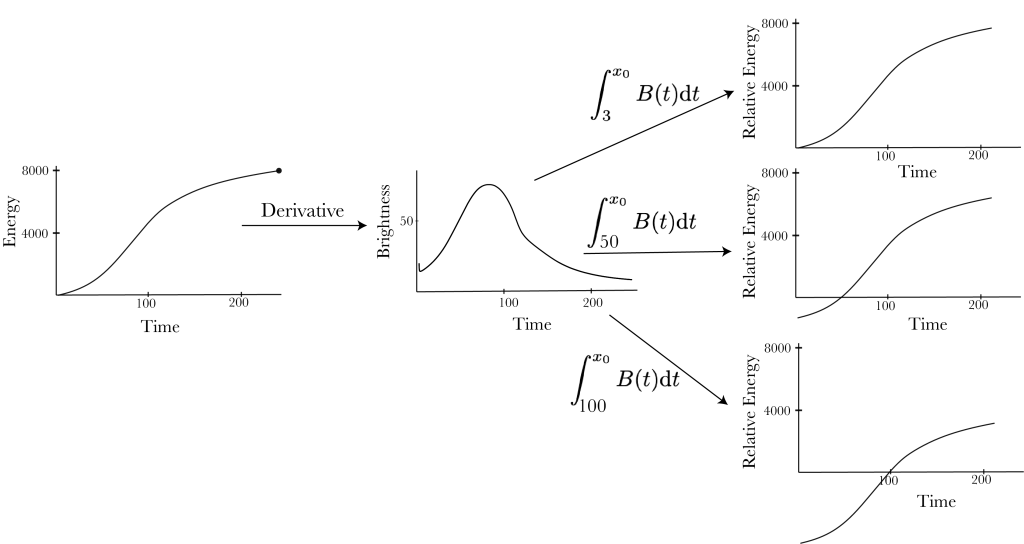
In this case, the integral comes second and so different integrals (which are vertical shifts of each other) give different vertical shifts of the energy graph on the left.
To repeat: the derivative of an integral of f is precisely f, whereas the integral of the derivative of f is f plus a contant.
The exact same thing plays out with derivative and antiderivative rules. For example, integrating \(\scriptsize 2x\) gives a vertical shift of \(\scriptsize x^2\), while differentiating any vertical shift of \(\scriptsize x^2\) results in \(\scriptsize 2x\). Introducing these visuals early can give students a powerful conceptual framework for understanding the Fundamental Theorem, its role in the course, and the importance of the ever-unpopular “+C.” And, it lets them see that differentiation and integration are (almost but not quite) inverse operations in the vein of addition and subtraction.
If you like this want a copy of the book, click here.
Leave a Reply