Free and editable problems you can use in your class

Edition 1.2 of Living Calculus is done! Click here to order a copy.

Part of the cover of Living Calculus
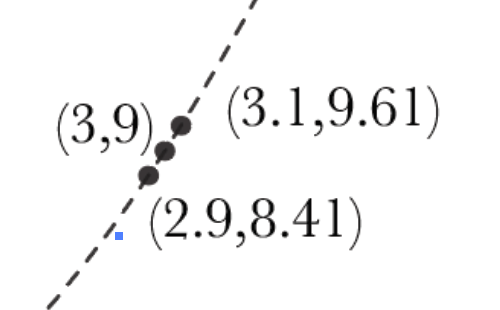
  • Introducing the Power Rule

    The power rule poses an exceptional opportunity for students to explore a topic beginning with inductive pattern finding rather than deductive proof. I often hear math teachers talking about how finding patterns is an essential part of math. Which it is! But how often do we model this for our students? All too often, teachers present a formula (like the power rule) before giving students a chance to think and spot patterns for themselves. If we want students to see that spotting patterns is essential to mathematics, then this needs to be a core part of our teaching practice.

    (more…)
  • Is the MVT the Integral of the IVT?

    In a word, no.

    But it’s a great question with a really interesting answer. If you ever have a student in your calculus class ask this question, then you are doing something very right.

    (more…)
  • Visualizing the Mean Value Theorem

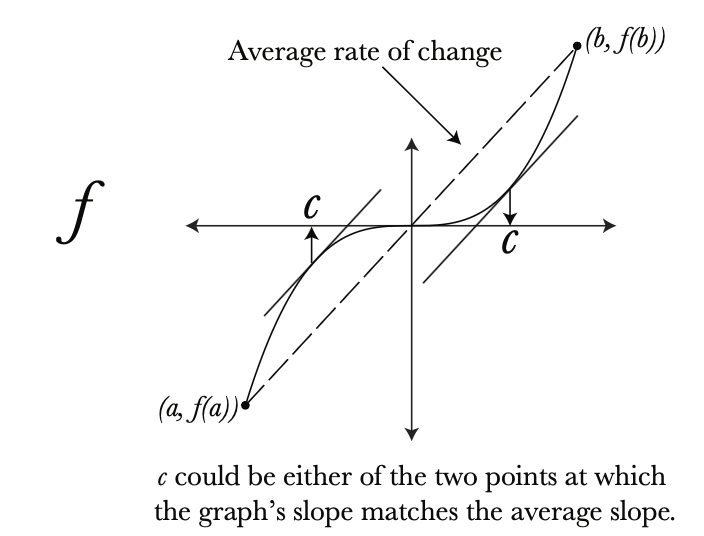
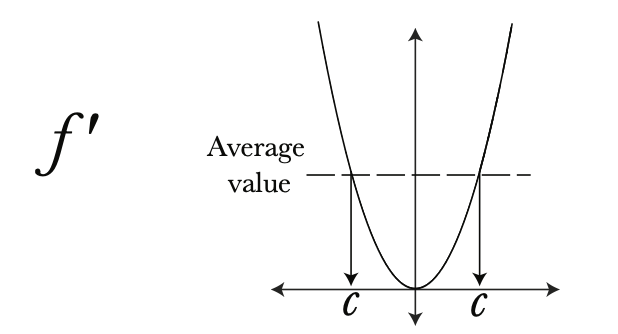
    Here, we can see the point(s) at which the average rate of change matches the instantaneous rate of change. If we view the same situation from the perspective of f’, then we get this picture:

    (more…)
  • Average Value and Average Rate of Change

    One connection I like to make in my class is that, on any interval, the average rate of change of a differentiable function is equal the the average value of its derivative. This follows directly from the Fundamental Theorem, since the average value of \(\scriptsize f’\) on \(\scriptsize[a,b]\) is $$\frac{\int_a^bf'(x){\rm d}x}{b-a}=\frac{f(b)-f(a)}{b-a} .$$From my point of view, this connection is what justifies the use of the word “average” in describing a rate of change. What are we averaging? The derivative, which is to say the rate of change, of f. What are we averaging over? The entire interval \(\scriptsize[a,b]\).

    (more…)
  • Enduring Understandings For Derivatives

    As I’ve been preparing to give a talk at NCTM in October, I’ve been thinking about my much-beloved growth rate activity and why I like it so much. Thinking about this helped me name three enduring understandings for derivatives: I want students to

    1. Understand the difference between change and rate (or ratio) of change.
    2. Understand slope (or rate of change) as quantity which is dynamic, and is therefore worth viewing as a function in its own right.
    3. Understand the distinction between slope over an interval and slope at a single point.

    Understandings 1 and 2 are, perhaps, the most important to the widest range of students: these are concepts that everyone should understand in order to be an intelligent consumer of quantitative information. And yet understanding 3, which is of interest to a relatively select audience, is what often gets the most emphasis in calculus classes. Moreover, I believe that students have a hard time engaging with number 3 if they don’t first understand numbers 1 and 2. So, I start my class by teaching understandings 1 and 2, then get to understanding 3 later in the year (See here for more thoughts on delaying limits).

    (more…)
  • Introducing the Chain Rule Part 3: Teaching Related Rates First

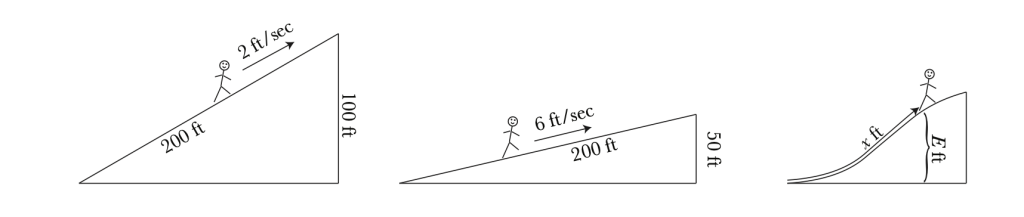
    We have someone walking up a hill, so that their elevation is a function of position which, in turn, is a function of time. How fast are they gaining elevation?

    (more…)
  • Introducing the Chain Rule, Part 2: Connecting Composition and Related Rates

    One reason that so many students struggle with the chain rule is that they never really got the point of composition in the first place. Sure they can “put one function inside another,” but they are missing this essential point:

    Composite functions appear in situations where the value of one quantity is determined by another, which in turn is determined by another.

    Functions appear in situations where the value of one quantity is determined by the value of another.

    Understanding composition this way builds a natural bridge between related rates and the idea of composition. For example, consider the following scenarios:

    (more…)
  • Scaffolding for a few of my favorite problems

    I’ve tried producing a document giving some guidance to help others use a few of my favorite problems in their classroom. This includes problems I use on the chain rule, product rule, fundamental theorem and power rule. My goal with this document is to explain some of what I do to set each problem up and debrief it at the end of class, and to describe what comes before and after a particular problem.

  • What is Calculus (Part 4: Graphs and Equations)

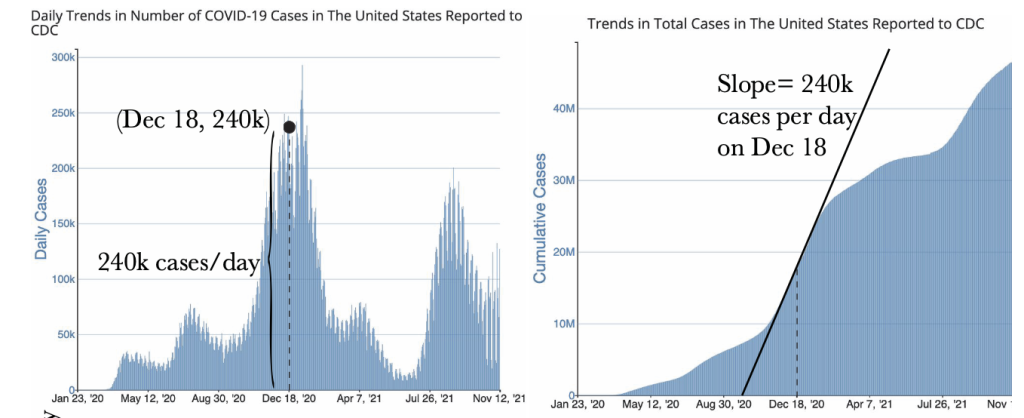
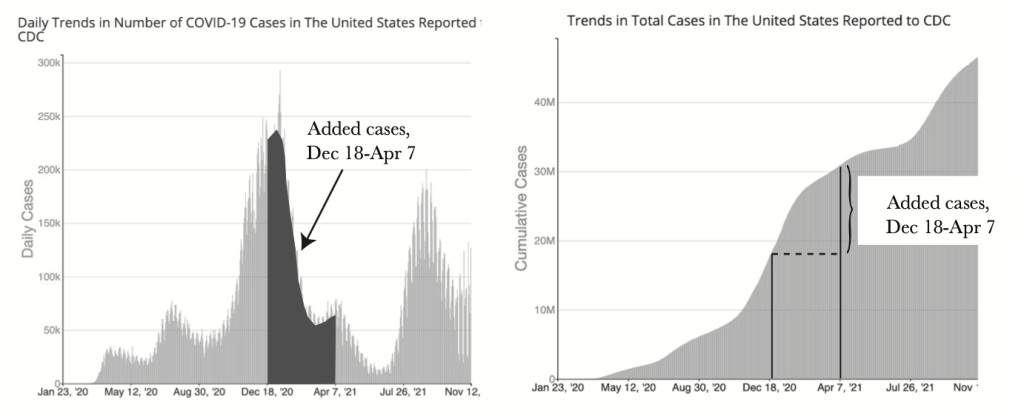
    In the first post in this series, I said that calculus is the branch of math dedicated to understanding rate of change and accumulated change.  In that post, I Illustrated two relationships between the graphs of cumulative COVID cases and daily COVID cases.

    First, the slope on the graph of cumulative cases on a given day is the same as the corresponding value (y-value) on the graph of daily cases:

    Second, an area between two dates on the graph of the daily case rate equals the change in the value between the same two dates on the graph of cumulative cases.

    (more…)
  • What is Calculus (Part 3: Why we need limits)

    In the first post in this series, I claimed that calculus is the branch of math devoted to understanding the connection between a rate of change and an accumulation of change.

    In the second post, I connected this to the idea of area: specifically that the perimeter of a circle determines the rate of change in its area, per unit change in its radius.

    In this post, we will see why limits are important for understanding these ideas.

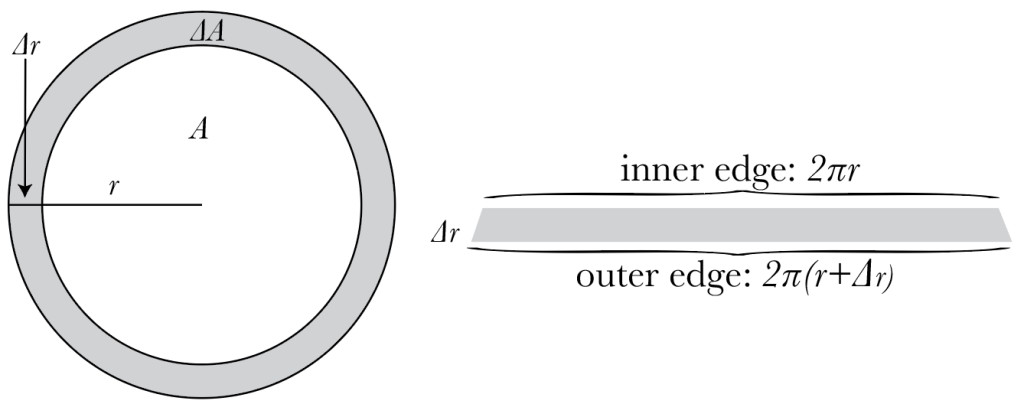
    First, we will change notation a bit. Before, we let dr represent a “small” change in radius, without saying how small dr actually is. Now, let us say the change in the radius is some specific number that we call \(\scriptsize\Delta r\). The number \(\scriptsize\Delta r\) may be anything, small or large: it is just some amount we are adding to the radius of a circle.

    Consider the strip formed by increasing a circle’s radius by an amount equal to \(\scriptsize\Delta r\). We previously treated this as a rectangle, but this isn’t really right, because the top and bottom have different lengths:

    (more…)