In the first post in this series, I claimed that calculus is the branch of math devoted to understanding the connection between a rate of change and an accumulation of change.
In the second post, I connected this to the idea of area: specifically that the perimeter of a circle determines the rate of change in its area, per unit change in its radius.
In this post, we will see why limits are important for understanding these ideas.
First, we will change notation a bit. Before, we let dr represent a “small” change in radius, without saying how small dr actually is. Now, let us say the change in the radius is some specific number that we call \(\scriptsize\Delta r\). The number \(\scriptsize\Delta r\) may be anything, small or large: it is just some amount we are adding to the radius of a circle.
Consider the strip formed by increasing a circle’s radius by an amount equal to \(\scriptsize\Delta r\). We previously treated this as a rectangle, but this isn’t really right, because the top and bottom have different lengths:
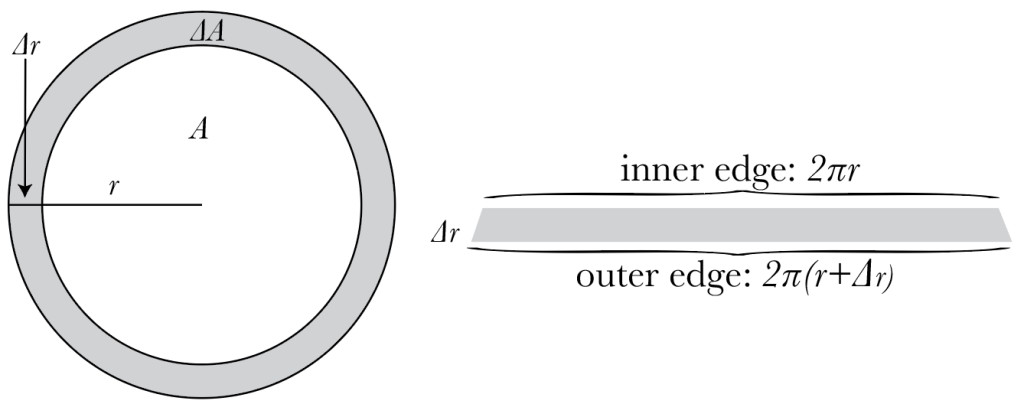
The top of the not-quite-a-rectangle added strip area comes from the inner edge of the added ring, which has radius r and length \(\scriptsize2\pi r\). On the other hand, the bottom of the not-quite-a-rectangle comes from the outer edge of the strip, which has a radius of \(\scriptsize r+\Delta r\). The length of the bottom edge is therefore \(\scriptsize 2\pi (r+\Delta r)\).
The actual added area is somewhat bigger than \(\scriptsize 2\pi r\Delta r\), since \(\scriptsize2\pi r\) is the smaller side of the added strip. In the figure below, the maroon rectangle has area \(\scriptsize2\pi r\Delta r\), and we can see the actual added area sticking out on either end:

Thus, \(\scriptsize 2\pi r \Delta r\) is clearly less than the added area \(\scriptsize \Delta A\).
Similarly, a rectangle of area \(\scriptsize 2\pi (r+\Delta r)\Delta r\) is clearly more than the added area \(\scriptsize\Delta A\):

Combining these, we know that the added area is more than \(\scriptsize 2\pi r\Delta r\) and less than \(\scriptsize 2\pi (r+\Delta r)\Delta r\):
\[2\pi r\Delta r<\Delta A<2\pi (r+\Delta r)\Delta r.\]
If we want to know the rate of change per unit of added radius, then we can divide every part of this by \(\scriptsize \Delta r\). While \(\scriptsize \Delta A\) is just how much area we added, \(\scriptsize \frac{\Delta A}{\Delta r}\) is the rate of added area per unit change in radius. This gives
\[\frac{2\pi r\Delta r}{\Delta r}<\frac{\Delta A}{\Delta r}<\frac{2\pi (r+\Delta r)\Delta r}{\Delta r}.\]
Canceling \(\scriptsize \Delta r\) on the left and right then gives us
\[{2\pi r}<\frac{\Delta A}{\Delta r}<{2\pi (r+\Delta r)}.\]
In short, the rate of change in the area, \(\scriptsize \frac{\Delta A}{\Delta r}\), can differ from \(\scriptsize 2\pi r\) by at most \(\scriptsize \Delta r\). If we claim that \(\scriptsize \frac{\Delta A}{\Delta r}\approx2\pi r\), the error in this approximation must be less than \(\scriptsize \Delta r\).
As \(\scriptsize \Delta r\) gets smaller, the error in the approximation \(\scriptsize \frac{\Delta A}{\Delta r}\approx 2\pi r\) get smaller along with it. And, we can make the error in this approximation as small as we like, simply by picking a small value of \(\scriptsize \Delta r\). This is what we mean when we write
\[\lim\limits_{\Delta r\to 0}\frac{\Delta A}{\Delta r}=2\pi r.\]
The meaning of this limit is that the rate of change in the added area (\(\scriptsize \frac{\Delta A}{\Delta r}\)) can be made as close as we like to \(\scriptsize 2\pi r\), simply by picking a small value of \(\scriptsize\Delta r\). Indeed, this the point of a limit: limits exist precisely to deal with this kind of situation, where one quantity gets close (as close as we like) to some specific value.
Framed in the language of derivatives, the limit of this ratio is the definition of a derivative:
\[\frac{\text{d}A}{\text{d}r}=\lim\limits_{\Delta r\to 0}\frac{\Delta A}{\Delta r}=2\pi r.\]
Just as we saw in the last post, the perimeter of the circle (\(\scriptsize 2\pi r\)) gives the rate of change in its area.
But the idea of a limit allows us to refine this idea: the perimeter gives us the instantaneous change in area, in response to a very small change in radius. And, the smaller the change in radius, the closer the rate of change is to being precisely the perimeter \(\scriptsize 2\pi r\).
If you like this and want a copy of my whole book, please click here