The power rule poses an exceptional opportunity for students to explore a topic beginning with inductive pattern finding rather than deductive proof. I often hear math teachers talking about how finding patterns is an essential part of math. Which it is! But how often do we model this for our students? All too often, teachers present a formula (like the power rule) before giving students a chance to think and spot patterns for themselves. If we want students to see that spotting patterns is essential to mathematics, then this needs to be a core part of our teaching practice.
After doing some work with numerical derivatives, I introduce calculus with limits by showing my students this picture and asking them to approximate the slope of this graph at x=3.
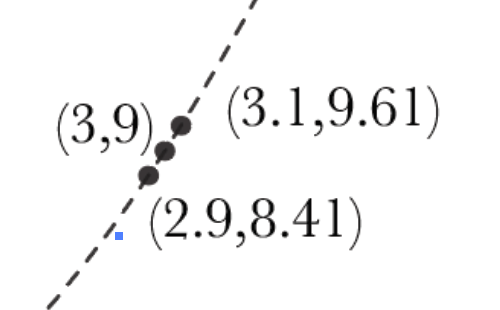
They give two approximations of the slope: one using (3,9) and.a point to the right, one using a point to the left. And I ask them “are you sure that the slope at the point (3,9) is between those two approximations?” And, if it’s an advanced class, there are usually at least some students who argue that the true slope at the point must be between those two values, because the slope is increasing and thus the slope on an interval to the right of (3,9) will be larger than the slope at that point, while the one to the left will be smaller. They are invoking the idea of concavity, months before being formally taught about it.
Then I ask them, “What information would you need in order to make this approximation better?” Because we have already done work with numerical derivatives, they have encountered the idea that we want to find the slope between a given point and the nearest other point we have available. So they are quick to ask if I can give them a point on the graph closer to (3,9). And I tell them that (3.01, 9.0601) is on the graph. And then they get a better estimate of the slope using this number.
And then I say, “Even better than giving you yet another, even closer point, I’m going to tell you that the equation for this graph is \(\scriptsize y=x^2\). Now, you can find the y-value at any point you want. And I want you to find the slope of \(\scriptsize x^2\) at \(\scriptsize x=3\), using (3,9) and the nearest other point you can.”
With a bit of nudging, they quickly convince themselves that the slope is 6 at x=3, and that getting closer to 3 makes little difference past a certain point. I do this activity before introducing limits, and yet they are already using the idea on their own. All of this gives an excellent way of talking about what a limit is: we say that 6 is the slope at x=3 because we may make the slope between two points arbitrarily close to 6, simply by brining the second point close to (3,9). It’s not just that the slope gets close to 6, its that we can make it as close as we could possibly want. Even without an algebraic proof, students are pretty convinced of this.
After having students explore the derivative of \(\scriptsize x^2\) at this specific point, I ask them to try several other points: x=1, x=2, etc. They quickly see that the slope is always double the x-value. Which is a remarkable thing! This rule brings order to what initially seems to be chaos. My students are delighted to be able to find the slope, at any point, without having to do another numerical calculation. After doing this with \(\scriptsize x^2\), I have them do the same thing with \(\scriptsize x^3\), at which point a meta-pattern emerges. Not only is the slope of \(\scriptsize x^2\) always equal to double the x-value, but this rule is part of a much bigger pattern.
And only after this whole activity do I finally give a proof of the power rule. This is true to the way math often works: mathematicians often firmly believe in a conjecture before proving it, and turn to the proof for understanding why something is true, not for figuring out what is true in the first place. This is part of my program to focus on “giving students authentic mathematical experiences” rather than focusing on “rigor” in a traditional sense.
This approach to the power rule starts with a legitimate problem (find the slope of \(\scriptsize x^n\)) and gives students a genuine experience trying to solve that problem. If you jump right in with stating the rule and giving a proof, you are depriving your students of an opportunity to think for themselves; starting with a proof eliminates the pleasure students get from discovering a remarkable pattern on their own.
If you like this and want a copy of my whole book, please click here